Storage tanks with a dedicated fire withdrawal
Livestock storage that also has a separate outlet, and a volume held back for emergency use.

Fire. / Infrastructure
Agricultural water infrastructure can provide additional wildfire-response value when it is designed and approved for that purpose. The types below are configurations to study. They are not a list of built Ranch PRO emergency-water sites.
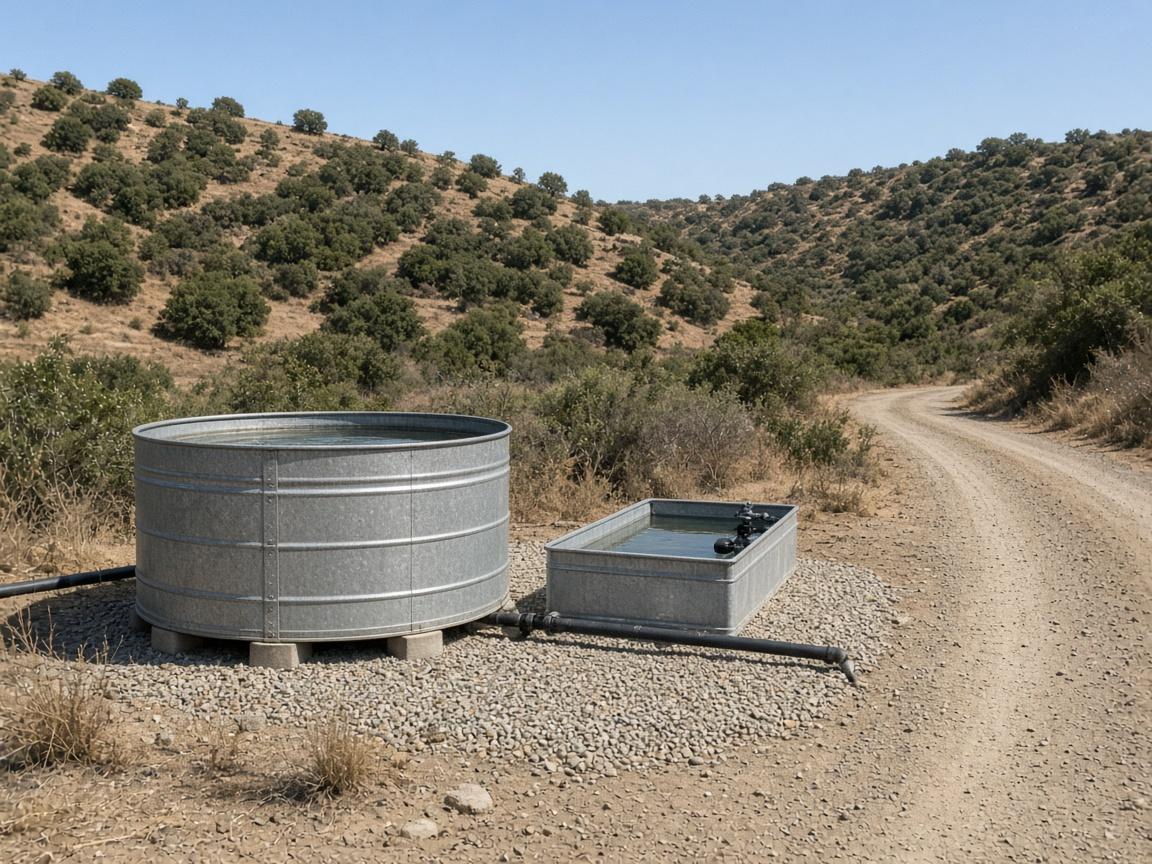
A herd on a large territory needs stored water and a way to move it. That agricultural system is the starting point. A wildfire-response role is an addition, and only where the source, the reserve, the access, and the approvals support it.
Ranch PRO does not treat a livestock trough as a fire engine fill, and does not treat a ranch pond as a helicopter dip. Those uses, if they are ever real at a given site, come after design and after the responsible authorities accept them.
Each type is a possible design, not an installed asset and not an approved emergency facility.
Livestock storage that also has a separate outlet, and a volume held back for emergency use.
A point a fire engine can reach, with room to turn and a connection the engine can actually use. Access is a design problem, not a label.
A water body studied for aviation use. Approach, depth, obstacles, and agency acceptance all have to be shown. No dip site is approved on this page.
Animals drink from the trough. The storage that feeds it can be protected so an emergency reserve is not drained by everyday use.
How water reaches parts of a territory that do not have their own source. Reliability and maintenance belong to whoever operates the line.
Equipment that can be staged when a fixed point is not the right answer. Staging still needs a host site, a water source, and permission to be there.
A project that proposed dual-use water would have to answer these questions. The list is a design agenda. It is not a completed design, and it is not an approval.
A single project can need several authorizations at once: a water right or other legal right to the water, a grazing authorization, construction permits, environmental review, and a fire agency’s own acceptance of a water point.
Those reviews can be coordinated so the same facts are not assembled five times in isolation. Coordination does not collapse them into one permit. Each statutory authorization stays with the agency that issues it.
Ranch PRO does not claim a permit, a water right, or a fire-agency acceptance for any dual-use site.
If a water point is designed and approved for emergency use, the responsible fire agency can put it on its maps and into its operational plans. That step is the agency’s. A point that is not in the plan should not be described as available to an incoming crew.
This website does not publish exact locations of private infrastructure, nonpublic water facilities, or anything that would show a vulnerability. Public pages stay at the level of the concept.
A dual-use project can have two benefits: water for a livestock operation, and water for wildfire response. Those benefits are why more than one party might help pay for it.
Any shared financing would be agreed for a specific project, with a specific owner of the asset and a specific maintenance duty. This page does not announce a grant, a public appropriation, an insurer contribution, or any other funding commitment.