Fire. / Approach
Landscape-scale grazing, as an operating model.
A herd on a territory, a vegetation outcome that can be checked, and a livestock business that can last. This is the model Ranch PRO is developing. It is not a record of treatments already completed.
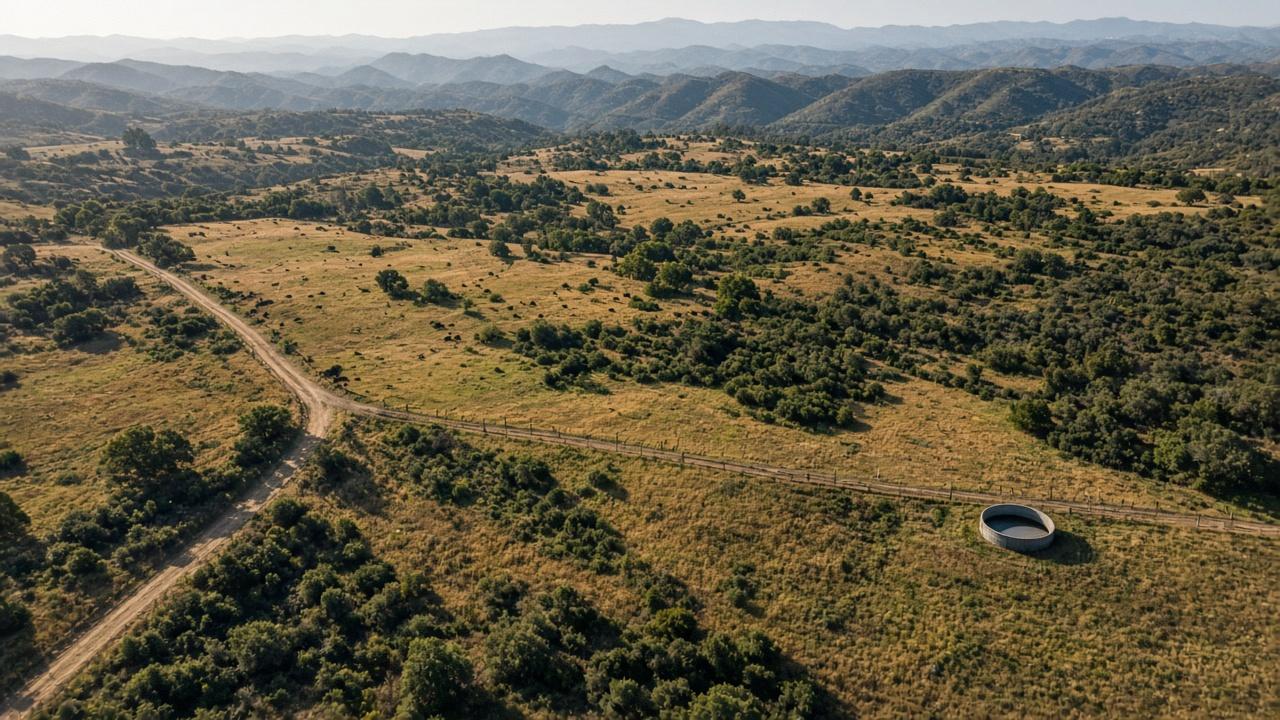
The landscape-scale grazing thesis
Working lands are wildfire infrastructure. The thesis behind Fire. is that a professional livestock operation, held on a large territory for years rather than days, can be one part of how a region manages fuel.
The model joins three things that are often contracted separately: livestock production, vegetation management, and water infrastructure that could serve both the herd and, where it is approved, emergency response.
Ranch PRO is developing this model. Nothing on this page is a measured treatment result, an executed agency contract, or a permit.
Why fragmented contracts undermine scale
A short contract on an isolated parcel can be the right tool for that parcel. It is a poor way to keep a regional herd. Each new site means another gather, another trip, and another setup, and the water and the people do not remain as a standing capability.
Fire. is aimed at the opposite pattern: fewer, larger territories and relationships measured in years. The comparison is structural. It is not a claim that every small targeted-grazing business should stop. That work remains useful in its own applications.
Regional operating territories and seasonal rotations
A territory is a set of pastures and vegetation communities a herd can move through as the season changes. The rotation is there to match forage, animal welfare, and the treatment objective of each place.
It is not a claim that every acre is grazed every year, and it is not a published season-of-use for any county. Where animals go, and when, belongs in an authorized plan for that land.
How a vegetation program would move from access to the next season’s plan. This is a conceptual diagram, not an operating history.
- 1Land access
- 2Grazing authorization
- 3Livestock deployment
- 4Vegetation outcomes
- 5Monitoring
- 6Adaptive management
How the herd carries its own economics. Related to the landscape system, and distinct from it.
- 1Livestock investment
- 2Forage utilization
- 3Animal growth and reproduction
- 4Harvest and market channels
- 5Reinvestment
These are related, and they are not the same system. The herd’s commercial life does not replace authorization, monitoring, or the choice of vegetation tool. Vegetation work does not replace a market for the animals.
Multi-species vegetation management
Cattle are for grass and herbaceous fine fuels, where forage and terrain are suitable. Sheep are for selected grass, forb, and mixed herbaceous vegetation. Goats are for browse: suitable shrubs, regrowth, and accessible woody vegetation.
Which species is used has to follow ecological suitability, authorized forage use, animal welfare, and a treatment outcome that can actually be reached.
Ranch PRO does not claim that goats can economically remove mature chaparral at landscape scale. That would take site-specific evidence. None is offered here.
Grazing as part of an integrated fuels-treatment toolbox
Grazing is one vegetation-management tool among several. It is selected according to ecology, terrain, and the treatment objective. Prescribed fire, mechanical treatment, and other methods remain part of the toolbox.
Fire. does not describe grazing as a universal replacement for prescribed fire or for mechanical vegetation management.
Performance-based contracting
The contracting model Ranch PRO proposes would tie a multiyear operating relationship to vegetation outcomes and to monitoring, not only to the number of days animals are present.
This is a proposal. Ranch PRO does not claim an executed agency contract, a government endorsement, or a procurement vehicle that already exists.
Livestock production and economic sustainability
A herd is not a piece of rental equipment. Commercial livestock operators need grazing access they can plan. Repeated relocation between disconnected parcels raises operating cost.
Livestock production is an economic foundation of the model, not a byproduct to be ignored. Animal growth, reproduction, and ordinary market channels are what make a standing herd possible.
No profitability figure is published here. No wildfire-loss avoidance figure is published here.
Monitoring, ecological safeguards, and adaptive management
An operating program would need a loop: an authorization, a deployment, a vegetation outcome, a measurement, and a change to season, species, or method when the land does not respond as planned.
Safeguards sit inside that loop. Forage use has to be authorized. The species has to fit the vegetation. Animal welfare has to be a constraint, not an afterthought.
Fire. does not present field data. No large-scale treatment result is claimed. Adaptive management is described here as a requirement of the model, not as a study already completed.